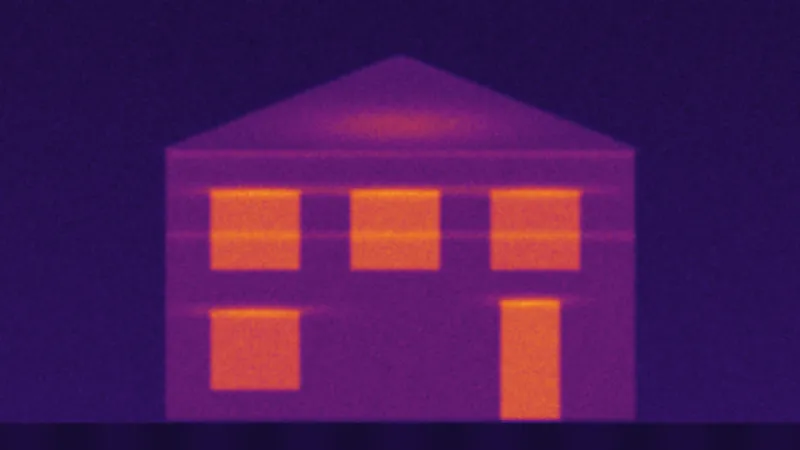
When the first cold days arrive, many homeowners want to check their insulation, find a heating leak or verify work done on the house. A thermal camera is the obvious tool, but still an unusual purchase. Should you borrow, rent or buy one? The answer depends less on the price tag than on what you will do with the device.
Option 1: a free loan
Many local authorities and energy agencies lend thermal cameras to residents to encourage energy renovation. In France, for example, Puteaux lends a camera for up to 48 hours, Eaubonne for up to three days between November and April, and an energy service near Montargis for one to two weeks. Some public libraries and energy advice centres offer similar programmes elsewhere.
Conditions tend to be similar:
- a refundable deposit, often a few hundred euros or dollars;
- a winter-only period, when the indoor-outdoor difference makes inspection useful;
- a booking that can take a while at the height of the season.
Ask your town hall, local energy agency or library. For a one-off check, it is by far the cheapest option.
Option 2: renting from a tool hire company
Equipment rental companies offer thermal cameras by the day or the weekend. Market guides in the United States cite about $50 to $100 a day for an entry-level 160 × 120 model, $100 to $175 for a 320 × 240 model and $200 to $350 for a 640 × 480 professional model. In France, a major rental company listed about €175 a day in September 2026 for an entry-level model and about €250 for a higher-end one.
Before booking, ask three questions:
- What is the native resolution? An entry-level rental unit may only offer 160 × 120 pixels or less. Beware of “display” or “enhanced” resolutions that do not match the sensor.
- Are the images radiometric? Without radiometric images or software, you leave with coloured pictures that cannot be reanalysed.
- Will the weather cooperate? A rental day often turns out mild, without the temperature difference you need. A camera you own can wait for the right cold night.
Option 3: buying an entry-level device
The market has changed a lot. In our database, several smartphone attachments with 256 × 192 native pixels sit in the under-€200 tier, and handheld cameras with the same resolution in the €200 to €500 tier. In other words, the cost of one to three rental days.
| Option | Indicative cost | Strength | Limitation |
|---|---|---|---|
| Free loan | Free, with deposit | No cost | Short duration, limited availability |
| Rental | ≈ $50–175 or €175–250 a day | No commitment | Fixed day, unknown hardware |
| Smartphone attachment | Under-€200 tier | Decent resolution, always available | Depends on the phone, ergonomics |
| Entry-level handheld | €200–500 tier | Robust, ready to use | Higher outlay |
| Professional thermographer | Quote | Method, interpretation, report | Cost per visit |
Price tiers are indicative and dated; see our price ranges page for the models concerned. To choose between an attachment and a handheld camera, read our detailed comparison.
The break-even point
The math is simple: if a paid rental is needed, a day or two already covers most of an entry-level device. Buying becomes even more attractive if you plan to:
- check the house before and after insulation or window work;
- monitor an electrical panel, a heating system or a solar roof;
- repeat the inspection every winter to follow a damp area or a defect.
A device you buy can also be resold. If you prefer the used market, our checklist before buying used will help you avoid bad surprises.
When to hire a professional
Neither a loan, a rental nor a purchase replaces a thermographer when the image must serve as evidence: a dispute with a contractor, an insurance claim, a handover of work. A professional brings a reproducible method, interpretation and a report. For leak detection on pressurised systems, they also have tools beyond the camera.
Getting your first inspection right
- Inspect when the indoor-outdoor difference is at least about 10 °C (18 °F), ideally early morning or at night: see when to scan a house.
- Lock the temperature span manually so rooms can be compared.
- Note the date, time, indoor and outdoor temperatures for each image.
To compare suitable devices, start with the home inspection guide, then the selector, setting the budget to the tier that suits you.
Frequently asked questions
How much does it cost to rent a thermal camera?
In the United States, market guides cite about $50 to $100 a day for an entry-level camera and $100 to $175 for a 320 × 240 model. In France, a major rental company listed about €175 a day in September 2026 for an entry-level model.
Is it cheaper to buy a thermal camera?
For a homeowner, often yes as soon as more than a day or two of paid rental is needed: several 256 × 192 smartphone attachments and entry-level handheld cameras cost less than €200 to €500.
Where can I borrow a thermal camera for free?
Some towns, energy agencies and public libraries lend thermal cameras to residents, usually for one day to two weeks, often in winter only and against a deposit.
When should I hire a professional?
When the image must serve as evidence, for a dispute, an insurance claim or a handover of work, and for leak detection on pressurised systems. A professional brings method, interpretation and a report.
Sources
- INSPECT & TEST Thermal imaging camera rental: prices (updated October 3, 2026)
- SELECTRA Thermal camera rental in France: observed prices (September 9, 2026, in French)
- NEOZONE French towns lending thermal cameras (updated December 22, 2025, in French)
Rental prices and loan conditions vary by branch, town and season. Check them before booking. The Thermogram has no commercial link with the rental companies or manufacturers mentioned.